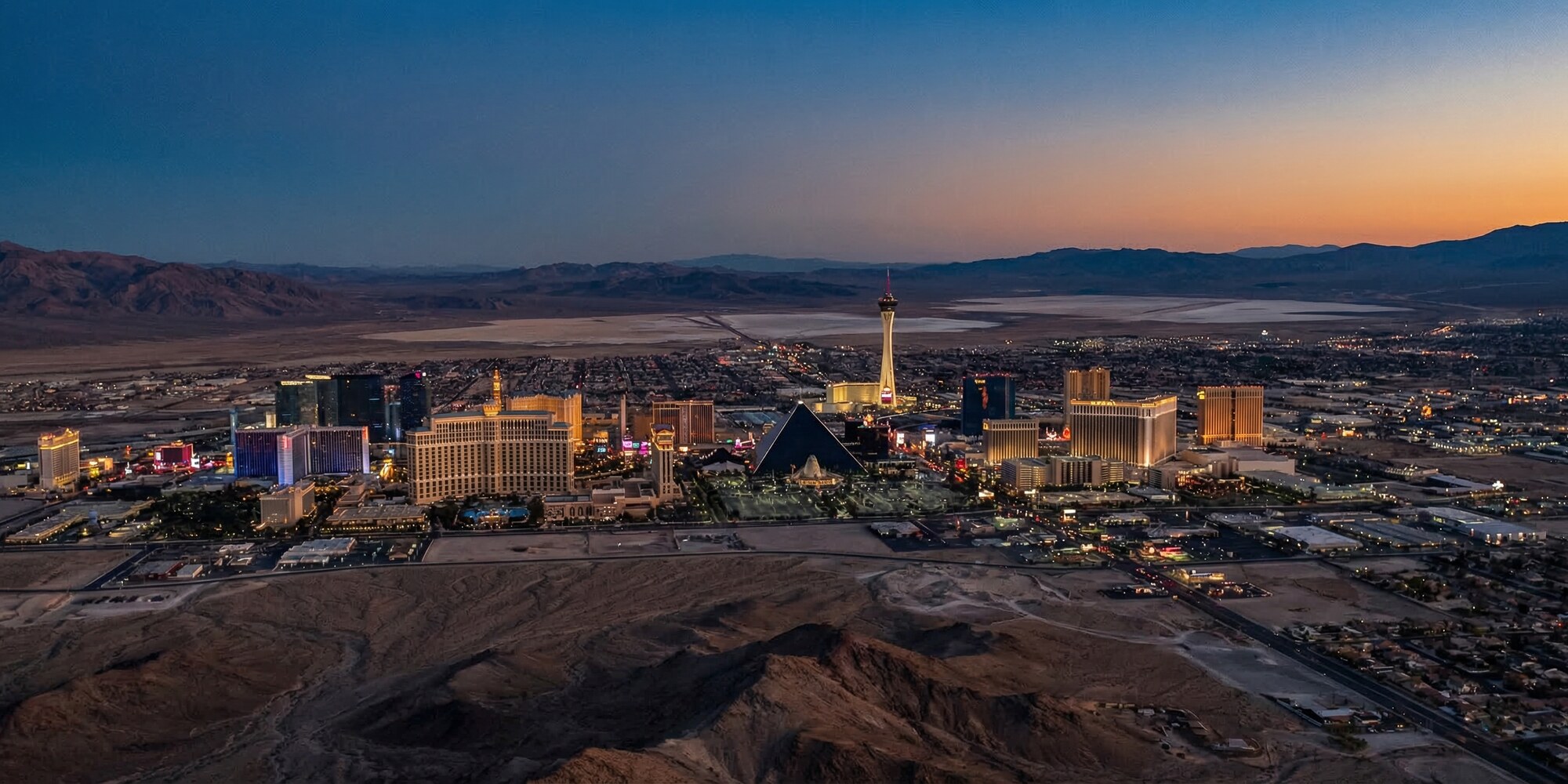
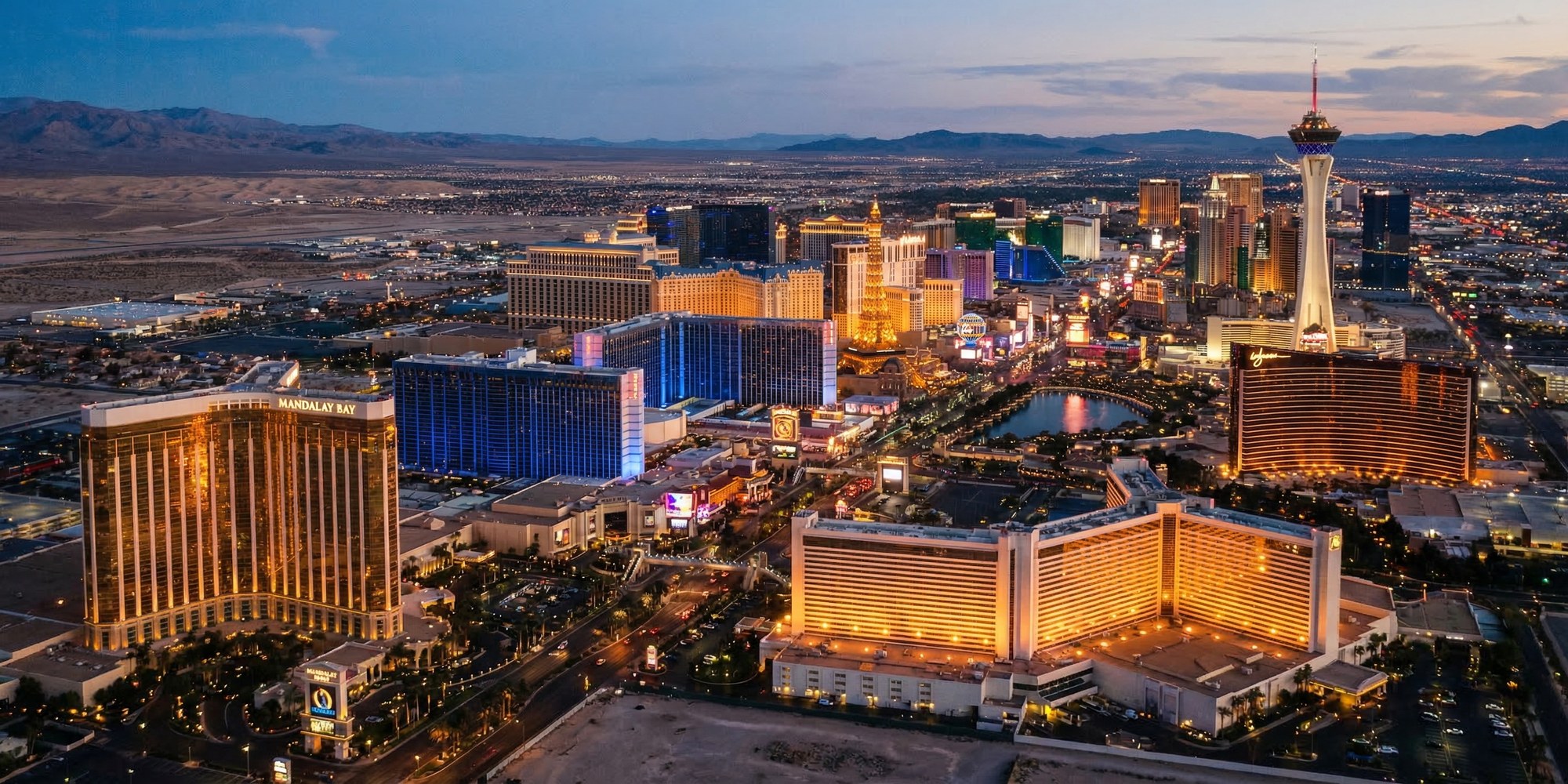
Las Vegas ended 2025 with a problem its boosters rarely acknowledge out loud: the city's economic engine stalled. Visitor volume dropped by more than 2.8 million people compared to the prior year — a decline of 11.3 percent that pushed the metro's unemployment rate above 5.5 percent, among the highest of any large American city. Hotels cut staff. Construction slowed. Business confidence fell to levels not seen since the late-2000s recession, according to UNLV's Center for Business and Economic Research. At the exact moment Nevada needed an argument for structural economic diversification, its legislature walked away from the most compelling one on the table.
Las Vegas's 2025 Tourism Shock Was Not a Blip
The tourism figures that emerged through late 2025 were not the result of a single bad quarter. According to reporting on LVCVA data, the Las Vegas metro shed approximately 4,700 jobs in the September–November window alone, concentrated in leisure, hospitality, and food service — the sectors that have always formed the core of Nevada's private employment base. Unemployment climbed to 5.5 percent and beyond, while the national rate remained considerably lower. UNLV economists warned that the visitor volume decline represented structural headwinds — tariff uncertainty, softening consumer confidence, and intensifying competition from other leisure destinations — rather than a temporary cyclical correction.
The pattern is familiar to anyone who watched Nevada's trajectory through 2008 and 2009, when gaming revenues collapsed and the state's narrow economic base left workers with few alternatives. Nevada's hospitality and gaming sectors have historically accounted for the dominant share of private employment; when those sectors contract, there is no industrial cushion to absorb the shock. That structural vulnerability has been discussed in state economic planning circles for decades. The film tax credit debate offered a rare moment when a concrete, evidence-backed alternative was actually within reach.
What Fifteen Years of Film Tax Credits Built in Georgia
Georgia enacted its film tax credit program in 2008 — the same year Nevada's economy was cratering alongside the national recession. The comparison over the subsequent fifteen years is instructive. By fiscal year 2024, film and television productions spent $2.6 billion in a single year in Georgia, according to the Georgia Department of Economic Development. Over the prior three fiscal years combined, the total reached $11 billion in direct production spending flowing through the state's economy — into hotels, catering companies, construction firms, equipment vendors, and local labor markets.
The physical infrastructure that followed was equally significant. Nearly $3 billion in studio construction investment was planned or underway in Georgia through 2025, with the state pushing toward 7 million square feet of dedicated soundstage space. That infrastructure doesn't evaporate when a production wraps; it anchors a permanent industry workforce and draws the next production before the previous one has finished post-production. Economists and critics have noted that Georgia's annual credit issuance runs approximately $1.35 billion — a real fiscal cost. But analyses focused narrowly on direct credit costs tend to exclude construction employment, property tax revenue from new studio development, tourism generated by filming locations that become destinations in their own right, and the multiplier effects that spread production spending through service sectors that would otherwise be invisible to the calculation. For Nevada, with its existing hospitality infrastructure and construction labor base, many of those secondary benefits would be additive rather than incremental.
The $4.5 Billion Nevada Turned Down — Twice
In early 2025, Sony Pictures and Warner Bros. Discovery, partnering with real estate developer Howard Hughes Holdings, announced a proposed 31-acre, 10-soundstage film complex in Summerlin — a planned community on Las Vegas's western edge. The project was not speculative. It came with specific commitments: $400 million in studio construction, $1.8 billion in mixed-use development including retail, restaurants, hotels, and a medical center, and a 15-year pledge of $4.5 billion in total Nevada spending. Unions representing Nevada construction workers — including LIUNA Local 872 — publicly projected 19,000 construction jobs from the studio complex alone. That is not a rounding error in a state where hospitality job losses were pushing unemployment to multi-year highs.
The legislative mechanism was Assembly Bill 238, which passed the Nevada Assembly before stalling in the Senate during the regular 2025 session. When the governor called a special session in November 2025, a revised version — AB 5 — again failed by a narrow margin. Opponents cited fiscal risk from the proposed transferable tax credit structure, which required approximately $95 million per year in credits for the major studio project and $25 million annually for smaller Nevada productions. The Nevada Independent reported on the internal legislative dynamics that ultimately sank both efforts, including concerns from senators who viewed the credit structure as an outsized commitment relative to Nevada's existing film infrastructure. The studios have indicated the Summerlin project remains on hold pending the 2027 regular legislative session — but in a competitive incentive environment, on hold is not the same as waiting patiently.
What This Means for Nevada Business in 2026 and Beyond
The argument against the film tax credit centered on fiscal risk. The data from 2025 reframes that argument considerably. Nevada's genuine fiscal risk is not a $95 million annual credit against a $4.5 billion capital commitment — it is continued structural dependency on an industry whose cyclical volatility has now been demonstrated twice within twenty years. UNLV's CBER is projecting partial visitor recovery in 2026, with roughly 40 million visitors expected — approximately 1 million more than 2025, but still below 2023 levels. That is a recovery, not a transformation.
Georgia's experience does not promise that a film tax credit turns every beneficiary state into Hollywood South overnight. What it demonstrates is compounding: the first productions attract infrastructure, infrastructure attracts more productions, productions attract a permanent skilled workforce, and that workforce becomes a competitive moat that is genuinely difficult to dismantle. Nevada already holds assets that matter — experienced hospitality and construction labor, a built-out hotel and catering ecosystem that production companies can immediately deploy, geography that offers desert, urban, and mountain settings within driving distance, and a time zone that eases West Coast production coordination. The missing piece has never been capacity. It has been the policy signal that tells studios Nevada is a reliable long-term partner rather than a perennial maybe.
For Nevada business leaders tracking the economic impact of this policy moment, the 2027 legislative session represents the next real window. The question is whether the state arrives at that session with a revised credit structure and a coalition that has addressed senators' fiscal concerns — or whether it arrives having watched another two years of gaming and tourism volatility demonstrate, once again, that diversification deferred is risk accumulated. The workforce pipeline that a film industry creates does not develop in a single legislative session; it develops over years of consistent policy. Nevada is now years behind Georgia, New Mexico, and Louisiana. The cost of that delay is not hypothetical — it is measured in the 4,700 jobs that disappeared from Las Vegas's hospitality sector in a single quarter while the state legislature debated whether to invite a different kind of employer in.